
LONDON’S VICTORIA AND ALBERT MUSEUM CELEBRATES DESIGN AND DISABILITY EXHIBIT, A CALL TO ACTION FOR THE COMMUNITY
By: Hillary LeBlanc
With advances in technology, communities are increasingly gaining the tools they need to better navigate disability. From adaptable housewares and thoughtfully designed adaptive clothing to the use of social media as a powerful tool for connection and advocacy, the disabled community has driven meaningful progress in design—making strides that feel significant, even as there remains much more work ahead.
The Design and Disability exhibit at the Victoria and Albert museum in London’s South Kensington area shares the radical contributions of Disabled, Deaf, and neurodivergent people and communities focusing on the design history from the 1940s to now. Upon entry, guests can sit, orient themselves and watch an audio description of a British Sign Language video welcoming guests. Maps on an entry table describe the exhibit in plain text, large print, a tactile map and even describe where various sensory experiences are.

Image courtesy of www.the-ndaca.org.
The first immediate section allows space to explore how Disabled makers visualise and express their own identities across fashion, photography, demonstrations, graphic design and zine culture. Fashion has always been a means of expression, not only in an interpreted way but also by using design as a form of protest. The first section shows a display of T-Shirts that were used to advocate for safe spaces for the Disabled community with slogans like “Access is Love” and “Piss on Pity”. The exhibit also has a huge tapestry with the phrase “Disabled People Fight Back / Equality / Nothing About Us Without Us”. A lot of these shirts were worn at protests and demonstrations in the 1990’s created by the Disabled People’s Direct-Action Network.
In the continuation of the first section of the exhibit, fashion continues to be a highlight. The fashion show ‘Everything Opens To Touch’ by Sinéad O’Dwyer is displayed on TV. O’Dwyer created a fully accessible fashion show in 2025 in Coppenhagen, partnering with Hair&Care to support having Blind and low vision guests and models. The show was fully audio described, and tactile swatches were passed out to attendees so they could feel the designs.
Kathy D. Woods is also featured. In 2012 she made a collection for Little People, including a leopard print dress which premiered at the Little People National Conference Fashion Show in Dallas, TX. She was the first African American to create a fashion line for Little People. Other remarkable designs include an adaptable kurta and dhoti ensemble by Malaysian adaptive fashion brand Dawn Adaptive. Not only are the kurta and dohti adaptable through velcro and snaps, the designs are made from recycled bedsheets and tablecloths. Slick Chicks’ adaptable underwear is also in the exhibit, originally designed for those with limited mobility due to post-partum surgeries. The brand Unhidden has shared with the V&A their adaptable trousers and hi-lo short which are adaptable for those with stoma bags or ports in their body to receive medical care.
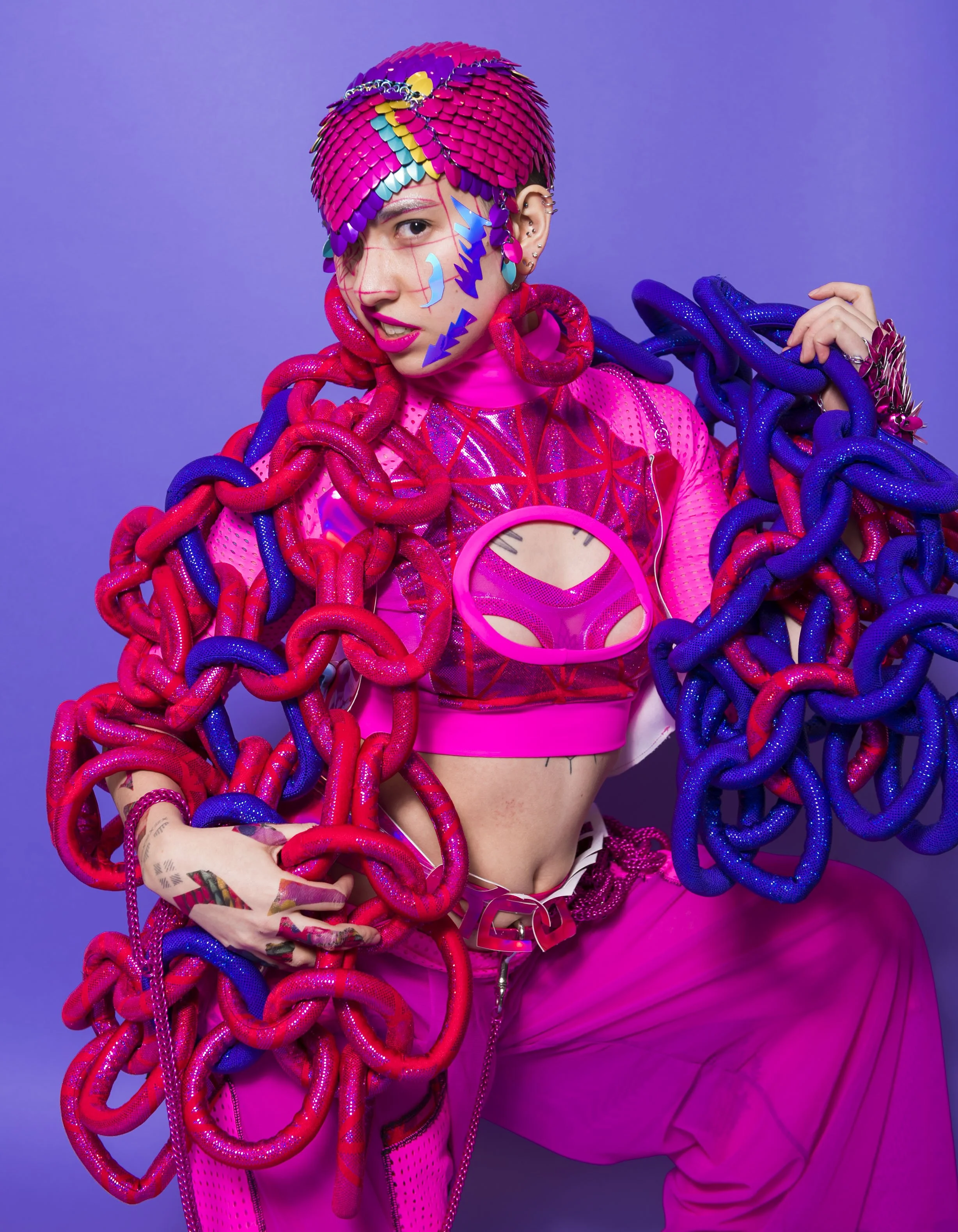
Credit: Rebirth Garments by Colectivo Multipolar
Design and Disability also asks how people can live inclusive lives at fashionable events. Maya Scarlette’s carnival costume is featured in the exhibit. She wore the piece in 2024 at Notting Hill Carnival. She has ectrodactyl, which affects fingers or toes. Despite this, she painstakingly hand-stitched her outfit.
Further pieces include colostomy bag covers made in various skin tone shades by brand Ostique, adaptive Crocs that have adjustable heel straps and slip resistant soles and hearing aid jewellery by the brand Deafmetal.
It may be no surprise that the section on ‘living’ also features more fashion, including a beanie with the Anti-Stairs Club logo. From 2019, the Anti-Stairs Club Lounge protest was a response to a 16-storey installation at the Hudson Yards in New York City which are not inclusive. There is also a Deaf Rave T-shirt and Woojer vest in the exhibit which, when used at Deaf Raves, allow Deaf clubbers to feel the music through vibrating, tactile discs that translate sound into a tangible experience.
One of the final pieces is a beautiful gown, made from drawings by artist Ntiense Eno-Amooquaye’s illustrations and kaleidoscopic printed textiles. The dress is intended to change the shape of the wearer’s body as a performance piece which originated through research into historic costume and avant-garde couture which Eno-Amooquaye took at the London-based collective, IntoArt, which allows for extensive art education in a supportive space.
The final piece, and the entire exhibit show just what is possible with the right tools and support systems at hand for all communities.
The Design and Disability exhibition at the Victoria and Albert Museum offers a powerful reminder that disability is not a niche consideration, but a vital lens through which design can be re-imagined for everyone. By centering lived experience, innovation and creativity, the exhibition challenges long-held assumptions about accessibility and aesthetics, and makes clear that inclusive design is not only possible—it is essential to shaping a more thoughtful, equitable future.