
BUILT TO FIT, NOT TO COMPROMISE: HOW JESSICA JOHNSON IS RE-ENGINEERING LINGERIE
By: Tiara Miller
In a category long shaped by tradition rather than precision, Jessica Johnson is taking a different approach. As the founder of Figiúra, she applies data, ergonomics and lived experience to reshape how lingerie is designed. Her work places intimate apparel within a growing space where fashion meets engineering, offering a more considered approach to fit.
Johnson’s entry into the industry began with a persistent personal challenge. Years after her initial breast augmentation, she found that traditional bras continued to fall short. Even after revision surgery, the same issues remained, reinforcing the absence of products designed with implant-based anatomy in mind.
“Fifteen years post-augmentation, I still struggled to find solutions in traditional bras outside of sports bras or bralettes that fit comfortably and provided the support I needed.”

Founder Jessica Johnson speaking at the Business of Fashion Conference during Startup Fashion Week / Credit: @V_ISUAL.S_
That frustration revealed more than a product gap. While the market has evolved to address a range of needs, from extended sizing to post-surgical garments, it has yet to meaningfully consider the structural differences of augmented bodies. Johnson’s response was not to keep searching, but to begin building.
Early conversations with other women became a critical part of that process. What emerged was a pattern of quiet acceptance. Many had adjusted to discomfort, relying on workarounds rather than expecting better design.
“What surprised me most was how normalized the discomfort had become. Women weren’t necessarily saying, ‘this doesn’t work’–they were saying, ‘this is just how bras fit now.’”
This insight reframed the challenge. The issue was not only technical, but perceptual. Expectations had been lowered over time, making poor fit feel inevitable rather than fixable.
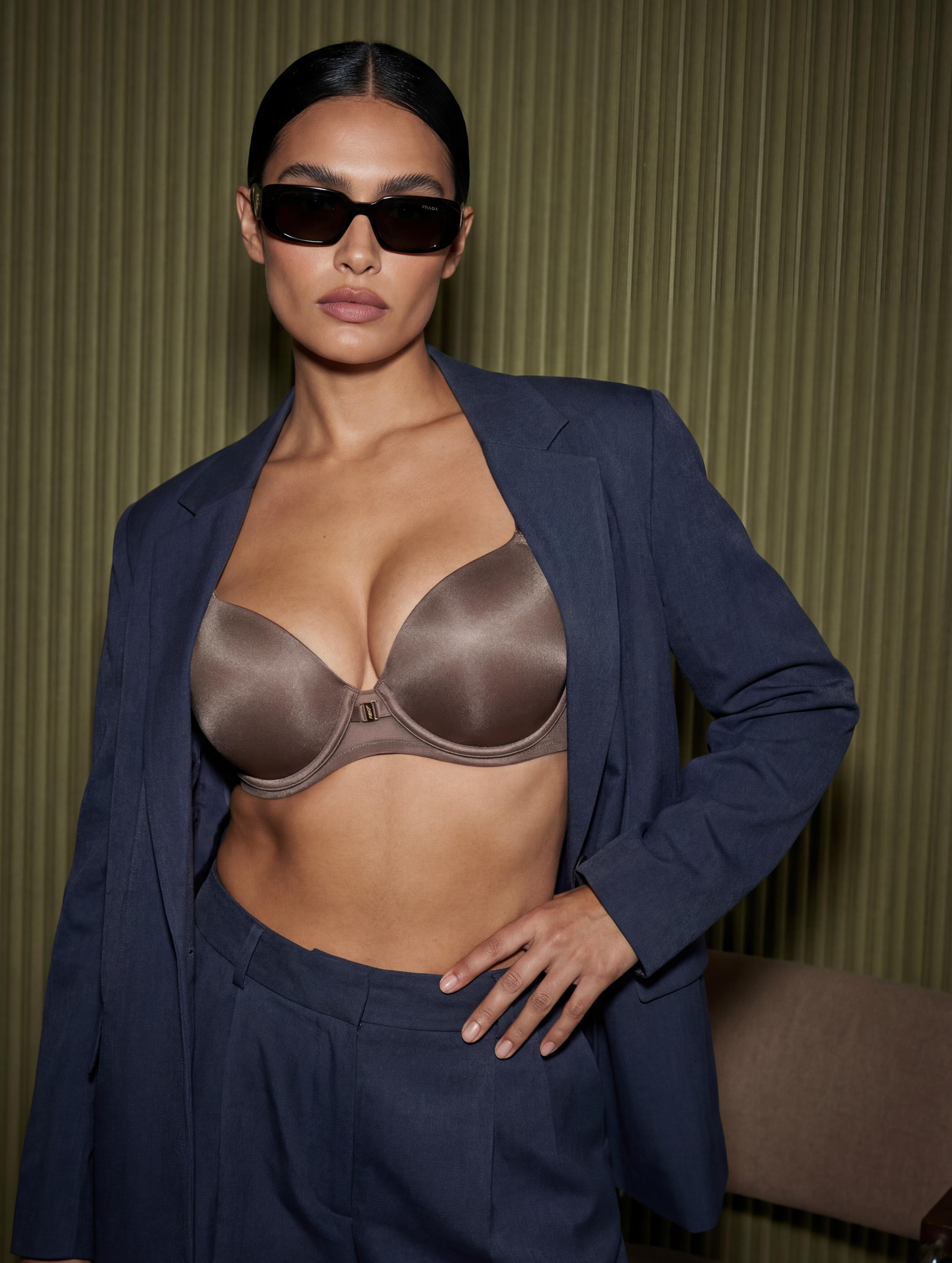
To address this, Johnson approached lingerie as a structural problem. Implant-based breasts differ in projection, firmness and positioning, requiring a distinct design framework. Instead of adapting existing templates, she rebuilt the construction from the ground up, prioritising alignment with the body’s natural shape.
Credit: Figiúra
“Traditional bras are built for softer, more distributed tissue. Implant-based anatomy is fundamentally different... more projected, more centered, sitting higher on the chest.”
This shift toward engineering became central to Figiúra’s development. Drawing on ergonomic principles and anatomical data, the brand focuses on precision rather than approximation. Design decisions are informed by measurable differences, allowing for a more accurate and consistent fit.
The approach also responds directly to the compromises many women described. In the absence of suitable options, they often alternated between comfort and appearance, rarely achieving both in a single garment. Johnson set out to eliminate that trade-off entirely.
“For me, the benchmark became simple: no compromise.”
This philosophy is reflected in the brand’s emphasis on “body-honouring solutions,” where garments are designed to support the body as it is, rather than requiring adjustment or tolerance. It marks a shift away from standardisation and toward a more responsive model of design.

Credit: Figiúra
“Women have been told to size up, size down, adjust, tolerate discomfort or simply accept that nothing will fit quite right. We take the opposite approach.”
In this context, inclusivity extends beyond size. It considers anatomy, experience and the varied reasons women may choose augmentation, positioning fit as both a functional and personal consideration.
Johnson’s background outside of traditional fashion has played a defining role in shaping this perspective. Without being tied to established norms, she approached the category with a problem-solving mindset, questioning long-standing assumptions around construction and fit. The result is a brand that sits at the intersection of fashion and femtech, where performance and design are developed in tandem.
That impact is most visible in the response from wearers. For many, the experience of a properly fitted garment is immediate and unexpected, challenging what they had come to accept as normal.
“There’s a very specific moment when the bra fits... the pressure disappears and they look up almost surprised. That’s when it clicked. We weren’t just improving something–we were introducing a completely new standard.”
As Figiúra continues to evolve, Johnson remains focused on refining both product and perspective. Ongoing engagement with customers informs future development, while the broader goal is to shift how the industry defines inclusivity.
By grounding design in data and lived experience, Figiúra offers a new framework for intimate apparel. It is one where function and intention are built into the foundation, and where innovation begins with a deeper understanding of the body it is meant to support.