
AI IS BECOMING CENTRAL TO SUSTAINABLE FASION
By: Prachi Khatri
The fashion industry produced 5 billion excess stock items in 2023, worth $140 billion in sales, as per the World Economic Forum. It is not just an overproduction but a loss of resources, i.e., water, energy, and waste generation.
Artificial intelligence as is no longer a futuristic concept and it may just solve this problem. The concept of AI is slowly becoming the backbone of how modern fashion companies market, design, and distribute clothing. As consumer expectations evolve over sustainability pressure, AI is becoming a powerful tool to reduce the environmental impact. But how is AI related to saving the planet?
Recent data suggest that over 35% of the fashion companies have adapted to AI for their handling operations, most importantly designing, inventory management, and forecasting. From marketing campaigns to customer relationship management, AI is penetrating every value chain in fashion. AI transforming the fashion industry has brought a lot of opportunities for sustainable fashion but also comes with a fair bit of challenges.

Credit: Carbonpact official website
If implemented strategically, artificial intelligence can drive significant waste reduction and energy optimization, hence improving the carbon footprints. For instance, traditional production models rely on forecasting trends many months in advance, leading to overproduction or wasted inventory that may not be sold if the trend fades earlier than the prediction results. AI, however, can analyze a huge amount of data, tracking what worked in the past and forecasting what demand may look like in the future more accurately based on a huge amount of data for many years.
Artificial intelligence can help brands improve sustainability by improving the scope of innovation in the fashion industry. One of the first steps is successful trackability. Innovations like the digital product passport (DPP) contain a digital record of the entire lifecycle of a garment from sourcing to chemical composition to manufacturing and carbon footprint. Every stage of a garment, from a thread to a textile fabric and finished product, can fit into a single QR code, easily accessible via a smartphone camera, with information available to customers at their fingertips.
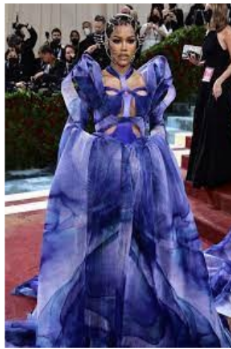
Credit: Researchgate
3D printed dresses worn by Teyana Taylor and Dove Camron for The Met
The availability of data not only simplifies trackability and authenticity of garments, but it also increases reliability and ease of tracking compliance standards. For regulating authorities this means it is easier to identify which brands meet the guidelines and those that don't. Fashion designers are also using AI to enhance their design patterns and automate concepts like patternmaking and developing prototypes.
The shorter developmental cycle transforms the design itself as well as minimizes the need for physical samples and wastage of fabric. According to data, AI-powered design tools can cut nearly 40% of the time to market, making brands resource efficient.
Smarter inventory management and enhanced personalization are some of the other benefits of AI helping brands recommend products that closely align with customer preferences. Many companies have now adapted to virtual fitting rooms and AI assistants for smart shopping so that customers can make better buying decisions when they see how a garment will look on their body in real time without lifting a finger or wasting time in trial rooms.
Despite many advantages, there are also some concerns around the concept of AI adoption eliminating jobs or reducing human creative capabilities. Excess reliance on AI requires more energy to train and operate advanced AI models and, hence, raises concerns about the overall impact of the same on the environment. Social media is already facing the concerns regarding AI with AI-generated models and influencers. Many AI-generated fashion campaigns are a concern for the authentic buyer looking for ethical representation.
However, the overall direction of AI evolution will continue to boom and expand into other aspects of fashion if it continues to allow fashion companies to make smarter decisions. AI integration with fashion operations is not only a reformation of the fashion industry but also a broader shift to a future data-driven fashion world.